
Airport, Historical Designations and Budget


Hello Friends,
Last Thursday night’s meeting was relatively short, but it included several votes worth discussing.
We have a conclusion on the airport, Council approved two historic landmark designations, and eliminated a more than decade-old energy regulation after staff concluded that the industry and the circumstances that originally justified the regulation had changed substantially.
In addition, I’m going to go back to the September 10th budget study session to detail how each council member responded to the initial submission. I am going to follow Bob Yates lead and call this section: “What They Were Thinking?”
Here we go.
The Record:
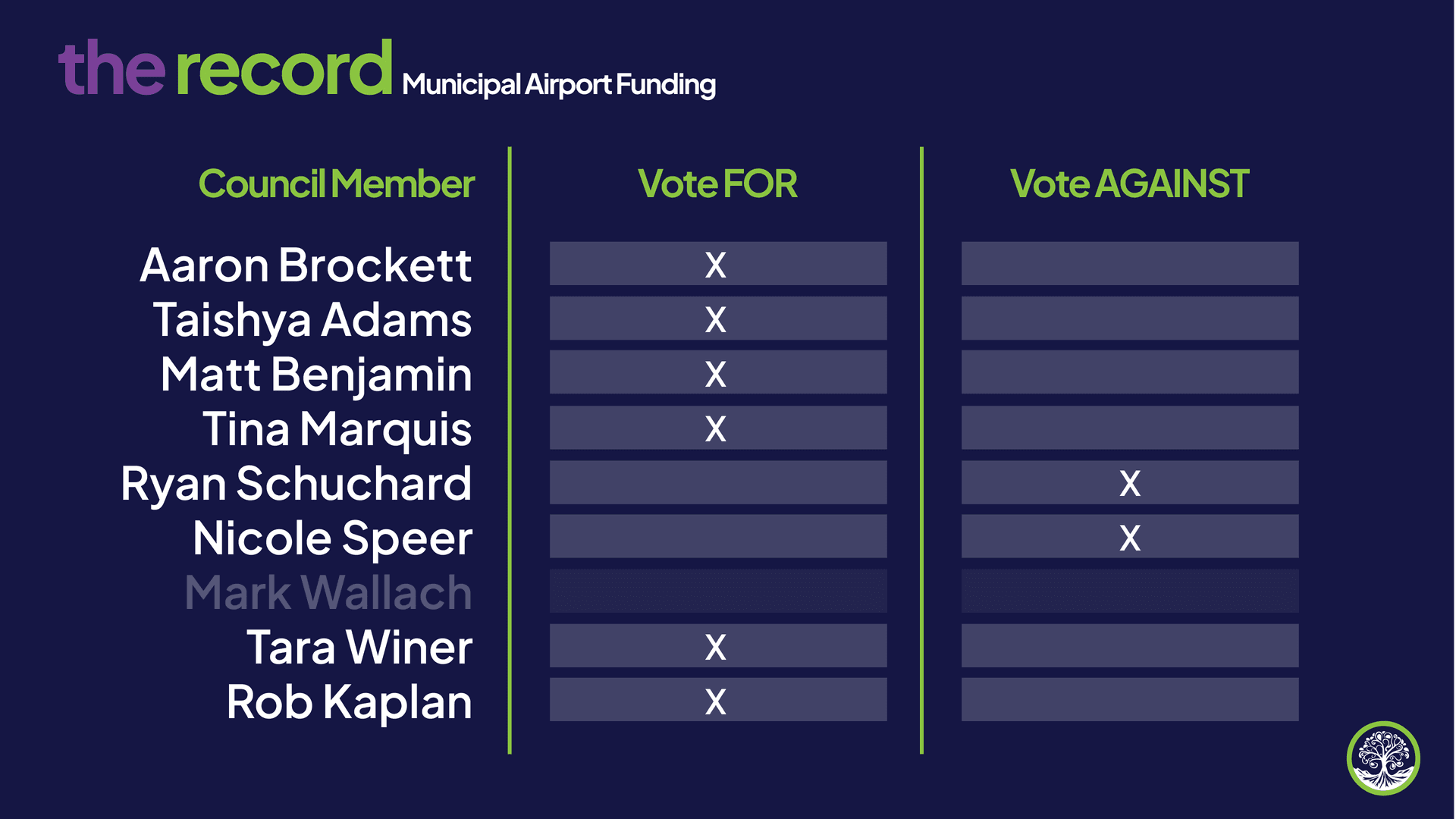
Consent Agenda: Municipal Airport Funding: Council Takes the Official Vote
Date of vote: 9/17/2026
Outcome: Passed 6-2 (No: Speer and Schuchard)
Category: Procedural/Other
What Happened
This one appeared quietly on the consent agenda, but it was a consequential vote.
Council approved an application for approximately $144,000 in Federal Aviation Administration funding to reimburse design and construction-administration costs associated with pavement maintenance at the Boulder Municipal Airport. The grant requires a relatively small local match and, importantly, positions Boulder to participate in the upcoming FAA/CDOT capital planning process. City staff said approval could allow access to another $1.9 million in potential grant funding for 2027 and 2028.
The significance of this vote went well beyond $144,000. In July, Council directed staff to pursue indefinite operation of the Boulder Municipal Airport and return with the first FAA grant application for Council approval. The September 17 vote was that return trip. The staff memo notes that the FAA’s current standard grant language asserts that previous land-acquisition grants bind Boulder to maintain the airport in perpetuity, although the City has disputed whether the FAA has the legal authority to impose that requirement.
So, while the July meeting established Council’s policy direction, this was the formal action that allowed the City to move forward with federal funding under that direction.
Why It Matters
For months, much of the airport discussion happened through study sessions, straw polls and “nods of five.” This vote was different.
Council had already indicated in July that the airport should continue operating indefinitely. On September 17, Council took the formal step necessary to begin accepting FAA funding again.
That distinction matters because federal and state grants are a major part of the airport’s long-term capital strategy. According to the City, the September approval is necessary to participate meaningfully in the upcoming five-year capital planning cycle; without it, anticipated allocations for 2027 and 2028 could be affected.
Jenny's Take
With all the talk about maintaining what we have, this was a necessary step in good governance. It means not creating more deferred maintenance while supporting an asset that can contribute to economic development and technological advancement.
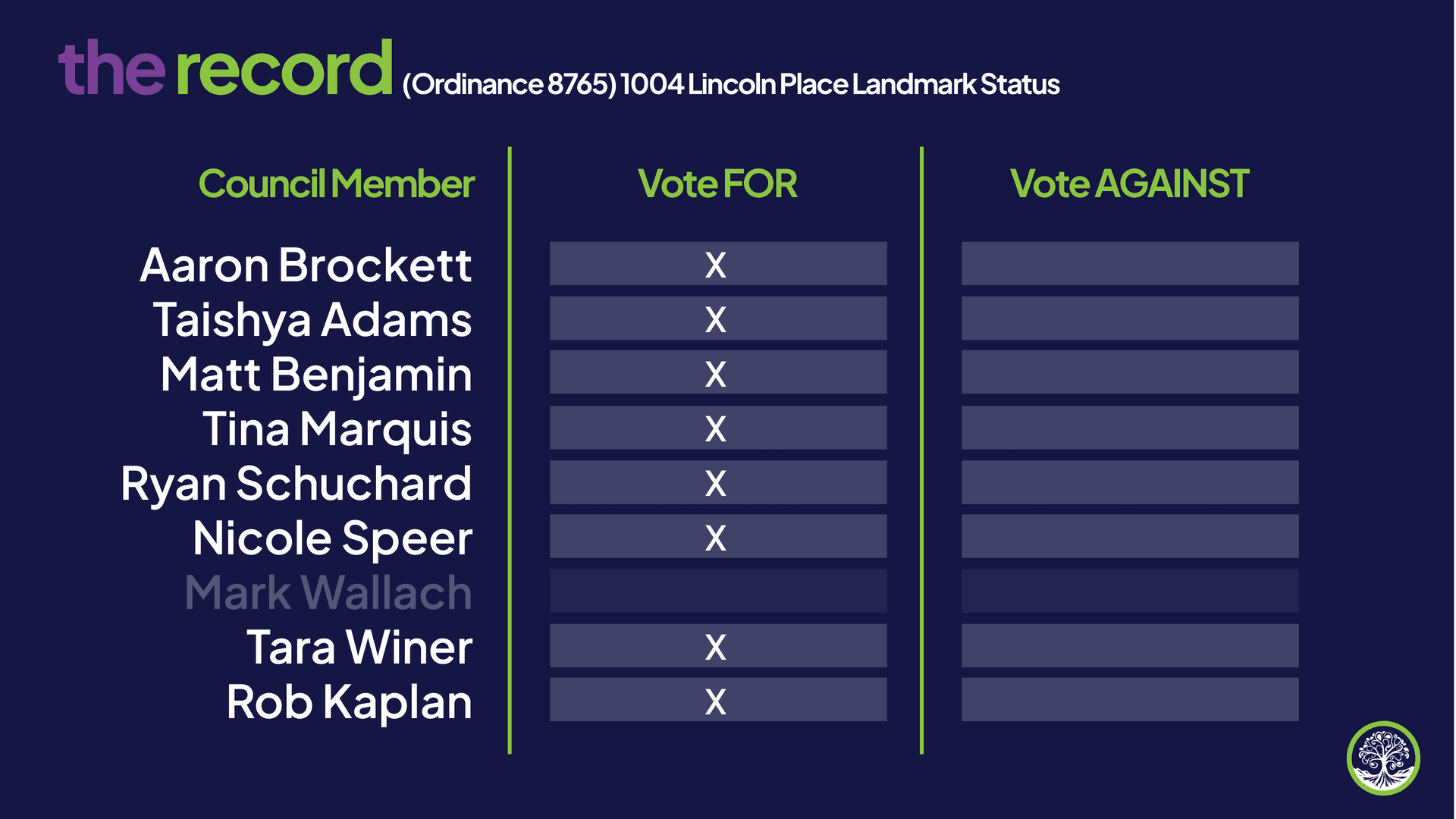
Public Hearing: Ordinance 8765- 1004 Lincoln Place, to be known as the Beard-Stoyva House as an individual landmark
Date of vote: 9/17/2026
Outcome: Passed unanimously 8–0
Category: Procedural
What Happened
Council unanimously approved Ordinance 8765, designating the Beard–Stoyva House at 1004 Lincoln Place as an individual historic landmark.
The home was built between 1906 and 1908 and was identified by the City as an exceptionally good example of Craftsman architecture with Tudor Revival influences. It also has historical connections to Boulder’s early development and the Texas-Colorado Chautauqua. The property had previously received a unanimous 5–0 recommendation from the Landmarks Board, and the owner supported the designation.
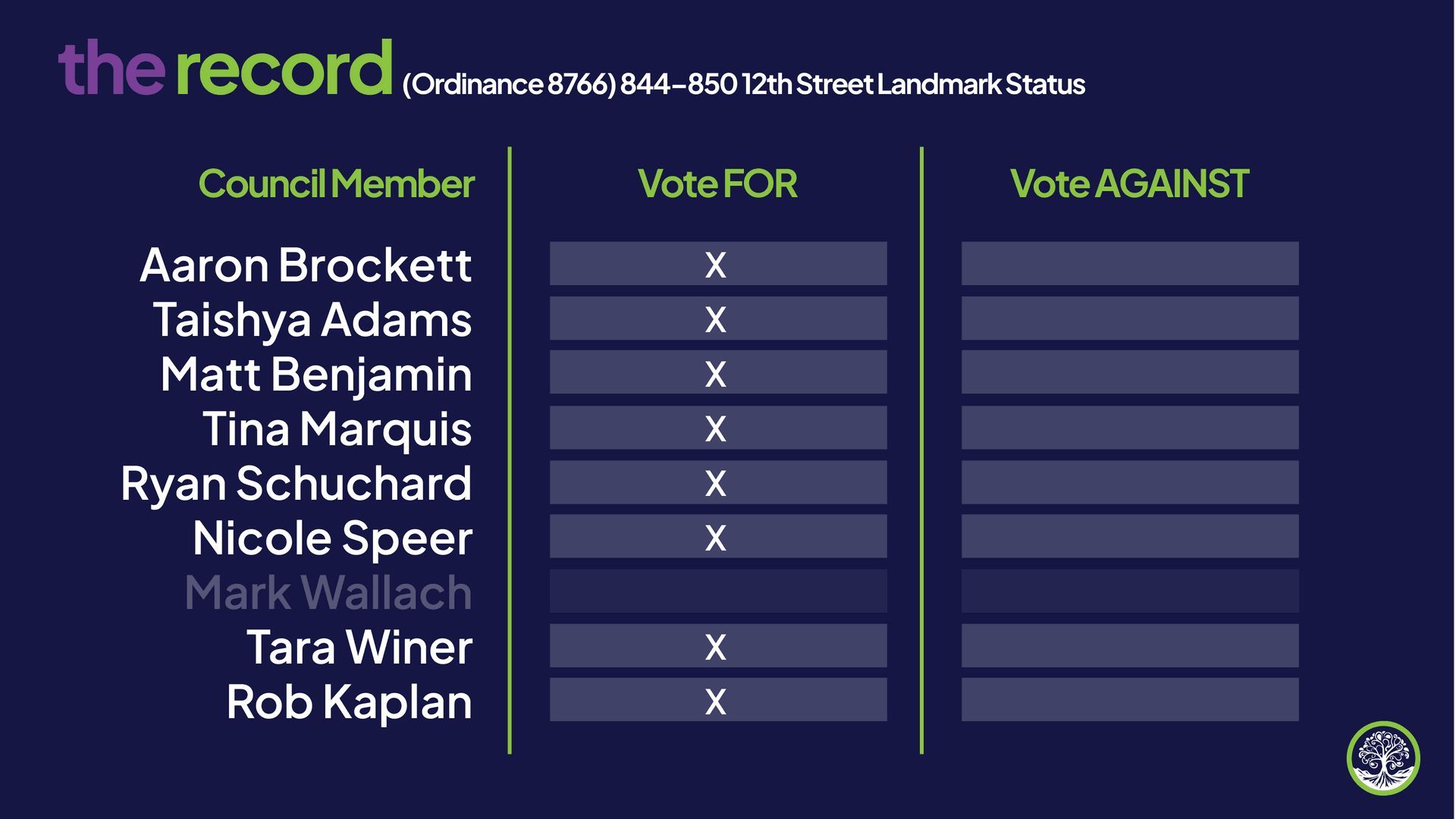
Public Hearing: Ordinance 8766- 844–850 12th Street to be known as the Heilman–Bedell–Stepanek Property as an individual landmark
Date of vote: 9/17/2026
Outcome: Passed unanimously 8–0
Category: Procedural
What Happened
Council also unanimously approved Ordinance 8766, landmarking two homes at 844–850 12th Street. The houses date to 1920 and approximately 1928 and are significant both architecturally and for the people who lived there.
The property has ties to Elizabeth Heilman, a prominent Boulder Red Cross volunteer during World War I, who commissioned architect David H. Holmes to design the front house. Later residents Grace and Florence Bedell were Home Economics professors who taught nutrition and other subjects during the Great Depression. The front house is also considered Boulder’s only remaining example of Holmes’ more modest Southwest Mediterranean-style work.
Like the Lincoln Place property, this was an owner-supported designation that had already received a unanimous recommendation from the Landmarks Board.
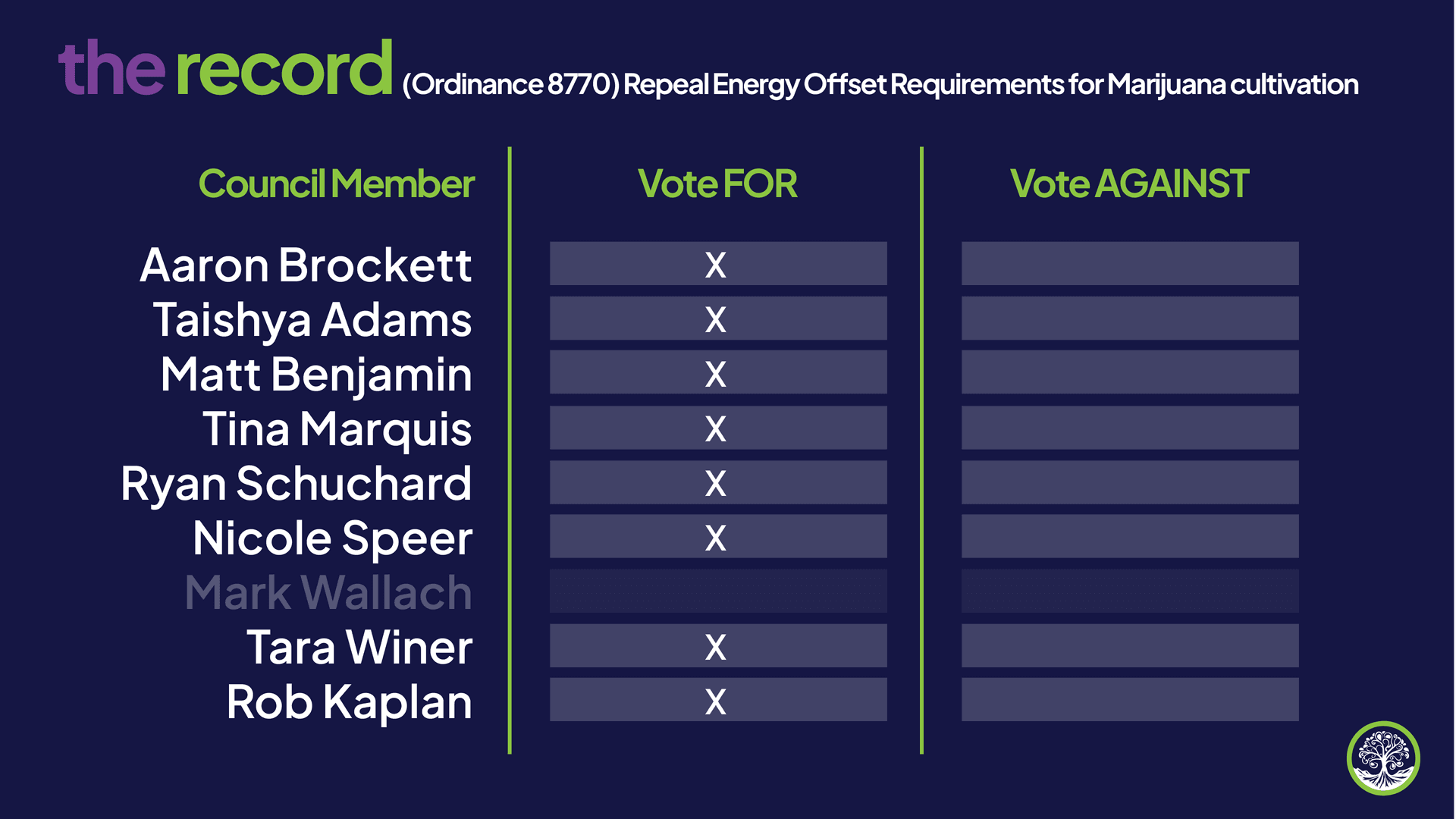
Public Hearing: Ordinance 8770- Amending Chapter 14 “Medical Marijuana” and Chapter 16 “Recreational Marijuana” repealing Energy Offset Requirements
Date of vote: 9/17/2026
Outcome: Passed unanimously 8–0
Category: Procedural
What Happened
The final public hearing of the evening involved something we don’t see very often in Boulder: Council eliminated a regulation. Ordinance 8770 repealed Boulder’s special energy-offset requirements for licensed marijuana cultivation businesses.
The requirement dates back to the early days of legalized marijuana, when indoor cultivation was expanding rapidly and required significant amounts of electricity. Boulder required cultivators to offset 100% of their electricity use through renewable energy, participation in solar programs or payments into the City’s Energy Impact Offset Fund.
At its peak, staff said Boulder had approximately 44 licensed cultivation businesses, accounting for roughly 3% of community energy use. Today there are only nine.
Staff told Council that the marijuana cultivation industry has contracted dramatically and that administering the requirement has become increasingly inefficient. Eight businesses dissolved in just the last two years, leaving approximately $75,000 in impact fees that the City could not collect.
The decline wasn't entirely unexpected. As far back as 2019, Boulder staff predicted that the number of local cultivation facilities would decrease substantially because of falling wholesale marijuana prices and competition from lower-cost growers elsewhere in Colorado. Since then, the broader Colorado cannabis market has contracted dramatically, while Boulder officials have also acknowledged that today's much thinner profit margins make local regulatory costs harder for businesses to absorb.
Of the nine remaining cultivation businesses, staff said five are already on payment plans. Staff recommended redirecting the time spent administering and enforcing the program toward broader climate initiatives with greater potential impact. Both the Cannabis Licensing Advisory Board and Environmental Advisory Board supported eliminating the marijuana-specific requirement.
Why It Matters
This is an example of what regulatory review can look like. The original policy addressed a significant issue when it was adopted: a rapidly expanding industry with substantial electricity consumption. But the circumstances changed. The number of cultivation businesses fell dramatically, the energy impact declined, and administration and enforcement became increasingly difficult.
Staff concluded that those resources could be put toward other climate initiatives with greater potential impact. Staff estimates the City will forgo approximately $50,000 per year in potential future fee revenue, although staff cautioned that actual collections were likely to be lower because of the financial condition of the remaining businesses.
Jenny's Take
I appreciated seeing staff come forward and say, essentially: this regulation once served a purpose, but the facts have changed.
Government shouldn’t measure the success of a regulation simply by whether it still exists. We should periodically ask whether a rule is accomplishing its intended goal, what it costs to administer, whether it is being applied fairly and whether those resources could have a greater impact somewhere else. In this case, Council unanimously agreed to repeal it.
The 2027 Budget: What They Were Thinking?
On September 10, City Council didn’t pass an ordinance or take a major vote. Instead, Council spent nearly three hours in a study session on the proposed 2027 City of Boulder budget. And there is a lot to unpack.
The recommended budget totals $552.6 million: $417.2 million for operations and $135.4 million for capital projects. Staff began the process facing a projected $6.3 million General Fund shortfall driven by flattening revenues and increasing costs.
Personnel represents 41% of the operating budget and 61% of the General Fund. The proposed budget assumes wage increases of 4% to 5%, depending on employee classification and collective bargaining agreements, while retirement, health and dental benefit costs are increasing above inflation.
To balance the budget, departments were asked to identify 4% savings. The result includes the elimination of 24 positions (13.1 filled and 11 vacant) but this budget also included the addition of 11.5 positions, totaling a net elimination of 2 filled positions.
The City also proposes eliminating the photo-radar van program for ongoing savings of about $1.2 million, reducing hours at Scott Carpenter Pool, closing Spruce Pool in 2028, eliminating child watch at East Boulder Community Center and reducing custodial service in city buildings from five days to three.
At the same time, Boulder is looking for additional revenue. The Transportation Maintenance Fee is expected to generate about $3 million (increasing to $6 million in 2028 and beyond), the recreational marijuana tax is increasing from 3.5% to 5.5%, utility rates are proposed to increase 5% to 7% for wastewater and stormwater/flood management, and voters will soon consider the $400 million Recreation and Safety Bond.
That’s the high-level budget picture. But study sessions don't give me votes to track. Instead, I listened to what each councilmember chose to focus on. Which brings me to a slightly different edition of Jenny on the Record. What They Were Thinking?
Ryan Schuchard: Can we maintain what we build?
Ryan focused on the constraints created by Boulder's restricted funds and on the proposed $400 million bond.
He asked whether Boulder now has a system in place to prevent newly renovated facilities from eventually falling into the same deferred-maintenance hole. Staff said new or substantially renovated buildings are intended to have roughly 2% of their current replacement value set aside annually for future maintenance.
He also focused on wildfire hardening and asked how we can better understand the cost benefits of certain types of mitigating efforts. He did not request any budget changes for this, but would like clarification of how money will be used and what is the cities role in fire hardening.
Tara Winer: What happens to the services residents actually use?
Tara focused on some of the most visible reductions, including Spruce Pool and recreation services. She questioned the transparency of the capital plan and the types of buildings. Does what we are produce or hope to produce go above and beyond what we can pay for. She also touched on snow and ice removal and the safety of residents throughout the winter.
She asked whether the City could rethink programs like SilverSneakers and other revenue models to help keep pools operating.Tara also questioned the elimination of the photo-radar van, asking why the City would eliminate something residents viewed as both a traffic-safety tool and a revenue generator. She mentioned Spruce Pool and the fact that will remain open through 2027 using one-time funding, but ongoing funding beyond that has not been identified. Lastly, she focused on the community request for an Internal Auditor.
These are the kinds of reductions residents actually notice. A relatively small line item inside a $552 million budget can feel very different when it affects a neighborhood pool or a service someone uses regularly.
Matt Benjamin: Are we funding what residents told us they care about?
Matt focused on the City's Fund Our Future engagement, how the city will prioritize core services, and questioned whether the priorities participants identified were clearly reflected in the budget.
The City said they are developing a tiered framework intended to distinguish critically vital services, mandated services, strategic priorities and community-enrichment services. That makes defining what government must do, what it should do, and what would simply be nice to do, increasingly important decisions.
He then made the evening's most specific proposed change: asking staff to examine approximately $2 million in additional eligible Climate Initiatives funding among other dollars from OSMP funds specifically for wildfire mitigation. That sparked one of the most important budget questions of the evening: If Council wants to make something a higher priority, what is it willing to make a lower priority to pay for it?
Taishya Adams: How representative was the community input?
Taishya questioned whether the Fund Our Future results represented a statistically valid sample of Boulder residents. Staff confirmed that they did not. The effort was a community-engagement exercise involving more than 500 participants, not a statistically representative survey.
She also asked questions about the circular economy and nature based solutions. In addition, she asked supplemental questions on wildfire such as evacuation and crisis around other possible climate issues.
That discussion led City Manager Nuria Rivera-Vandermyde to raise the possibility of moving toward a two-year budget process, saying it could create more time for prioritization and trade-off discussions rather than compressing them into the annual cycle.
Aaron Brockett: Before moving $2 million, what are we buying?
Aaron questioned Planning and Development services fund and why it has a higher fund balance and how to address things that we have one time funding for 20217 including Spruce Pool and the Day Services Center.
He also engaged with Matt's proposal to shift additional money toward wildfire mitigation. Aaron supported looking for additional wildfire resources but questioned shifting roughly $2 million away from climate work without more analysis. Tina similarly wanted greater specificity about what the additional wildfire money would actually accomplish before making that trade-off.
Tina Marquis: When should important budget conversations happen?
Tina focused on the gaps in the budget and how that would relate to the 2028 budgets and beyond. Some of the issues she raised revolved around wildfire and other tradeoffs that would need to be made. She noted that even with the new fees we continue to struggle and questioned how are we going to solve these long term.
She also focused on the policies around nuisance ordinances, specifically on the hill. Can this budget address those issues or if we can even enforce our existing ordinances and code compliance with the budget shortfalls we have. Lastly, she addressed the San Lazaro community and if annexation is that something that is possible within this budget cycle.
Nicole Speer: What happens if the bond doesn't pass?
Nicole raised the other side of the $400 million bond question: What happens if voters say no? She also talked about how our budget relates to our current frameworks.
The recommended budget itself does not assume the bond passes. The City's bond materials say that without new revenue, Boulder would eventually face additional trade-offs involving services, maintenance, fees or some combination of them.
Nicole also quoted the movie Office Space regarding “pieces of flair”. Relating that budget decisions are made within our adopted policy frameworks and if we want more policy (or flair) we should create or require that policy.
Rob Kaplan: What is actually a core service?
Rob touched on overall transparency and accountability of staff. He stressed that his questions were not an attack, but questioned Alpine Balsam specifically and asked that structurally we work differently to inform the community on large projects moving forward.
He clarified reserve funding and how council will be managing that process moving forward. He also requested the staff work to apply for different wildfire grants as he believed some were missed throughout the year.
Jenny’s Take
The numbers tell a pretty clear story. During the strong revenue years following the pandemic, Boulder added ongoing programs and expenses. Revenue growth began slowing in late 2023. The City experienced a mid-year shortfall in 2025, faced a projected $7.5 million General Fund gap in 2026, and entered the 2027 process with another projected $6.3 million gap. Staff described the recent flattening of sales and use tax and the resulting budget pressures during the study session.
At the same time, the City's cost structure keeps growing. Personnel consumes 61% of the General Fund. Wages are budgeted to increase 4% to 5%. Benefits are rising above inflation. And Boulder has aging infrastructure, contractual obligations and a substantial deferred-maintenance backlog.
That raises a question worth asking: Did the ongoing cost of city government grow faster during the stronger revenue years than the City's underlying revenues could sustainably support?
Personnel is the obvious place to start because it represents such a large share of the General Fund. City employees should be paid fairly and competitively. But the math still has to work. When more than 60 cents of every General Fund dollar goes toward personnel, even a seemingly modest percentage increase has a significant impact on the budget.
Then there is the Long-Term Financial Strategy. Staff described it as an effort to address fiscal sustainability, restricted revenues, deferred maintenance, alternative funding mechanisms and the City's heavy reliance on sales and use tax. In my opinion, it appears this “Long-Term Financial Strategy” became mostly about finding more ways to collect money vs finding ways to increase revenue. This one really caught my attention.
Because even with the new fees and if the $400 million Recreation and Safety Bond and residential vacancy tax passes, we are still in a financial crisis.
So residents may reasonably ask: How much of Boulder's long-term financial strategy is focused on controlling the cost of government, and how much is focused on finding additional revenue to support its existing commitments?
Then there is sales tax. The budget identifies Boulder's dependence on sales and use tax as a longstanding structural vulnerability. Staff attributes the current weakness primarily to economic conditions, state legislation and changing consumer demand; the budget materials do not establish that downtown public-safety conditions caused the slowdown.
But the broader economic question is still worth discussing. If businesses are dealing with theft, vandalism, disorder, rising labor costs, fees or regulatory expenses, those conditions can affect the business environment and deserve to be part of the economic conversation.
If Boulder depends heavily on sales-tax revenue, then maintaining an environment where businesses can operate and people want to shop, dine and spend time is part of the financial picture too. The same cumulative-cost question applies to regulation.
A regulation here. A new requirement there. A fee increase. A wage increase. A new program. A new study. Individually, each may have a rationale. Collectively, they have a cost. The budget itself identifies personnel, internal service costs such as fleet and technology, contractual obligations and other base expenses among the pressures facing the operating budget.
And perhaps the most interesting part of the entire conversation was what participants in the Fund Our Future exercise prioritized when they were required to make trade-offs: maintaining existing facilities, wildfire response and mitigation, encampment abatement, pavement maintenance, police emergency response, snow removal and paramedic response. Those sound an awful lot like core services to me.
Those are the choices Boulder will continue wrestling with as Council moves toward budget adoption in October. Because eventually, every priority has a price.
The Scorecard
The scorecard is the main tracker for major votes from each Council meeting. It will be updated every other week, both here and on my website, to keep you current on how Council decisions are shaping Boulder.

Thank you for reading!
Jenny
Founder, Jenny on the Record